WOTA 2026 2m/70cm SSB/CW Challenge Discussion

I think most old hands have noticed the decline in non-FM 2m activity over the last 2 or 3 decades.

2m SSB and CW have become mainly confined to contests and the odd special event. Some of us locals are interested in reviving those modes for every-day ad hoc QSOs like for WOTA and SOTA. We’ve long suspected that there are many amateurs in our region and beyond who have VHF multimode rigs and collinears at home that are being used nowadays only for FM.

Once in a while, if the weather’s decent, I’ll set my 4-element 2m Yagi (horizontally polarised) on a guyed pole on a summit and do a SOTA SSB/CW activation with my FT817. But it’s a faff and I wouldn’t normally bother especially if I want a quick activation. Activators – especially with Cumbrian weather – often won’t bother with a particular mode if it involves longer-than-usual set-up and pack-away times. Portable 2m SSB and CW using the same vertical whips / Slim Jim / J-pole for as for FM are no extra effort.

VHF contesters and DX’ers will always want to maximize their operating range and QSO rate and use their big horizontally-polarised Yagis for their events. I’m not suggesting trying to dovetail with their events.

We know when operating from hilltops that pretty good range and many QSOs are to be had on 2m FM with vertical whips so 2m SSB or CW should do at least as well. We just need to encourage more chasers and activators. Mark @M5TEA activated a bunch of WOTAs today with both 2m FM and 2m CW with 3 of us chasing, and it worked well and was a lot of fun.

I would like to get comments from anyone who thinks they would chase WOTA (or SOTA) 2m SSB or CW from home with just their vertical antenna and from anyone interested in activating with those modes. Of course, that wouldn’t exclude doing 2m FM as well.

If there’s sufficient interest, we could even organise a year-long WOTA event to encourage the revival of 2m multimode.

Your thoughts, please.

Andy G8CPZ / M0ALC

2 Likes

sounds like a plan Andy to generate more interest, I have a FT897+991A that would be perfect for chasing and a very old Yaesu 290R that will do ssb it’s only two and a half watts but still works well

Antenna wise for activating i have a 4 element beam (G7KSE) design and 3d printed moxon that could used vertical or horizontal. So yes i would be up for the challenge

Reg 2e0ldf

1 Like

I got back into amateur radio after a two-decade break doing portable 2m QRP SSB - later CW - with a secondhand FT290 Mk1 in the 1990s. It helped me get my Morse good enough to pass the Morse test. So, I have a soft spot for that radio.

I think it’s an excellent idea too. I’ll send an email to the internal WOTA group and report back. I don’t want to jump the gun but would you be open to it being non-band specific. As in, CW on any band counts? I can see that Phil @G4OBK might be up for chasing a few but doubt most summits are reachable from him using 2m.

It might prompt me to invest in a better setup at home too.

Good idea. I’d be up for a bit of SSB chasing but don’t have any portable non-FM gear for activating. 73, Phil

Apparently these cheap handhelds with double sideband will do the trick: Quansheng UV-K5. I’ll think about it! P

I don’t want this to be about just what I want, so perhaps the way to handle your suggestion to ask the WOTA community, would they like to see and participate as WOTA chasers and activators in:

  1. 2m SSB and CW activations [as well as FM], OR

  2. VHF & HF SSB and CW activations

So, I’ve tried to think about some pro and cons.

  • Due to the dominance of 2m FM QRP, WOTA has always been mainly a regional rather than a national or transnational scheme (not withstanding regular VHF contacts with EI, GM, GW, GI and GD). With Wainwright-only summits it’s clearly rooted in the Lake District. Is there much recognition of WOTA further afield especially overseas?

  • About 37 WOTAs are also G/LD SOTAs which regularly have HF activations. But most are SOTA alerts (with pull-through to the WOTA website). I suspect few of those activators and chasers are ‘WOTA aware’, uploading logs to WOTA, etc. It would be interesting to see what response a non-SOTA WOTA activation would get on HF.

  • Would widening the initiative to include all bands undermine the aim of increasing the WOTA SSB and CW activity on 2m as activators could get ‘easier pickings’ just on HF - and just do 2m FM? Even living in the county, I know I can’t hear and chase HF activators on Lake District hills on most HF bands.

Anyway, I think all of this is to be debated. Let’s see if there is a clear preference between options 1) and 2).

Andy, you make a very valid point about HF on combined SOTA/WOTA summits that I’d not considered with my suggestion.

There is also the potential for skewing the results even with 2m SSB/CW if the activator takes part in a non-WOTA related activity, such as the backpackers contest, if the scoring is one point per contact.

These things are always so complicated to work out!

Maybe a fairer system would award a point for each summit from which at least one non-FM contact is made?

The argument then that SOTA activations would skew results goes away on the basis that the majority of the summits are WOTA only. Subsequently, by definition those who want to gain points in the contest will need to activate multiple summits.

I’d then argue that non-FM contacts on other bands would also promote activity other than 2m FM handies. The microwave contingent would have an incentive, as would the prolific HF users. I know from experience that as we get more esoteric the setup time and backpack weights work against those frequencies/modes from a multi-site perspective.

However… thoughts then turn to digital modes such as C4FM that would be relatively easy to gain points with, just a case of having the right equipment and a suitably-equipped chaser.

Food for thought. I think we need to decide what the USP of the competition is at the core, maybe that is 2m CW or SSB only.

Regards, Mark.

Although I don’t have any gear at present for 2m ssb , I think Andy has brought up a good point .

Although relatively recent to the hobby I soon learned from those with more experience that 2m 70cm and 4m were not so popular as they were . Since last year I have tried to include 70cm and 4m in my SOTA WOTA activation . Mainly because I assume the SOTAs will have more people outside the area looking for alerts ? Tony M7OUD a regular activator from Yorkshire also does the same . People are often pleased to hear the activity and will relate that they can’t remember the last simplex 70cm or 4m contact and the knowledge someone on a hill might be out has encouraged them to dust off the old antenna or radio. I only tend to operate HF on certain SOTAs if as Andy said the weather is not too inclement for faffing about with extra gear and the antennas ..

I spoke to Bill M0DXT recently , he made the point that if we could use HF more with WOTA it might attract interest from across the UK and more , like BOTA , which is really well supported now. It could be something new for some people to chase ?

Richard.

2 Likes

Not seen these before Phil. Thanks for the heads up.

Every time we mention 70cm I can’t help think of Viki M6BWA who used 70cm exclusively on her SOTA outings to great success. Chameleon have made an off-the-shelf 70cm collapsible Yagi which would surely increase range for contacts if the chaser also had a 70cm Yagi at their QTH? This might also provide some unique contacts, which are a different prospect to asking a chaser on 2m to switch to 70cm to complete a contact. I’m sure many chasers would be happy to use 70cm and have a vertical antenna that supports it.

I’m currently thinking about how to improve my home QTH antenna setup from my modest X50. I’m looking at Yagi and rotator options. A combined 2m/70cm vertically-oriented Yagi would appear to be the most sensible option, given that 90% of my contacts are from people on the fells.

Mark.

When I announce an activation I usually state the order in which I’m working the bands . I always work 2m until the calls dry up , then switch to 70cms (as it’s the same radio and antenna and gives the other stations time to get sorted ) , then I get the 4m or HF gear out last .

We are probably the people to keep these out of fashion bands active , particularly UHF/VHF from our high vantage point . I’ve often had people calling in on 4m and 70cm who are not regular chasers but appreciate the opportunity to get the contact , and a couple of times people I’ve worked on 2m will say they have actually set the antenna and radio up specially for these bands because they knew someone was on , so the interest is likely still there ? For me it is interesting to see how the different bands perform on the day .

Richard.

1 Like

I have and FT817ND and have an old Sotabeams SB270 2m and 70cm antenna that I used for UKAC so will be up for something

1 Like

One fundamental issue with a challenge of this nature is that we currently don’t capture band or mode for either activator or chaser contacts.

This isn’t a difficult thing to add at a database level but adding the facility to the existing website is not something I’d relish.

So I think activators would need to use a new (yet to be implemented) mechanism for logging contacts. I may be able to modify the existing SOTA CSV import facility to store the band and mode, but better would be a new mechanism I have been looking to implement for some time to allow import via an ADIF file.

I really don’t know what people currently use for logging activation QSOs - what do active fell walkers use?

Cheers, Mark.

In any case, pencil and paper logging on summit. Once home:

  1. if non-SOTA WOTA and only a handful of contacts, I input them manually on WOTA website;

  2. if many contacts or joint SOTA-WOTA summit, I manually input into FLE and get FLE to create CSV file for upload to the WOTA database.

If it’s preferable to process logs separately for any future WOTA challenge (like the one discussed here), could there be a dedicated CSV upload link added to the WOTA home page? e.g. WOTA 2026 XYZ Challenge CSV Upload

1 Like

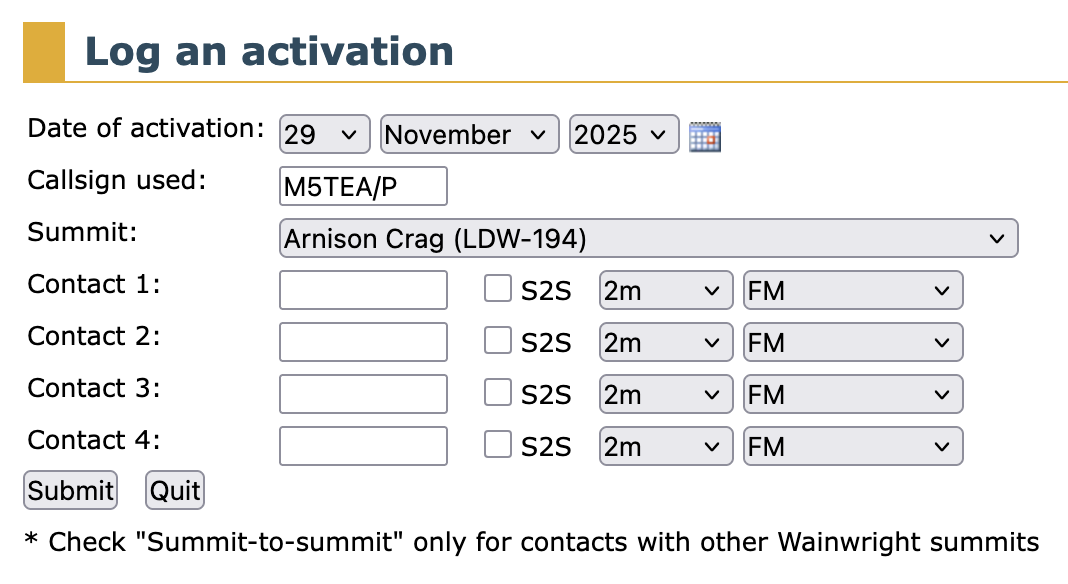
OK, I said I wouldn’t touch the PHP code, but I bit the bullet and have modified the logging form. There are now two additional fields on the form for each contact: band and mode. These default to 2m FM.

I’ve removed bands that I don’t believe are valid in the UK, and placed the most likely to be used bands at the top. The mode field also has the most common modes at the top.

If anyone has any objections or suggestions let me know. It’s not a great UI experience but it should log correctly - again if anyone experiences any issues let me know.

I’ll take a look at the CSV logging code next, and try and remember how that all hangs together!

The database now has a band, mode and frequency column in the activations log. Eventually when we have an ADIF import facility the frequency column can be pulled from the ADIF log.

Anyone who isn’t interested in logging a specific band and mode can just leave the defaults as is.

CSV logging only supplies the band and mode.

We don’t really need the frequency information for anything, but figured if it is supplied we’ll just log it - at least that is my thinking at the moment, but I might change my mind and remove it again.

Mark.

1 Like

It looks good Mark and a lot of work I did not think it would be so involved, I have the greatest respect for what you can do on the computer just logging is about all i can manage

Like Andy i log contacts on paper then transfer them when i get home. I don’t have a mobile phone since O2 switched of the network earlier this year

1 Like

Andy @G8CPZ picked up on the SOTA MT proposing a similar challenge for 2026.

Here is a summary of their challenge:

2m/70cm SSB/CW

The MT believes this provides a great opportunity for interesting QSOs in the coming year. Many activators and chasers will have access to equipment already for these bands and modes - whether the old faithful FT-817 and FT-857s or newer options like the 2m option for the KX3, the timely CW modification to the cheap and cheerful Quansheng handhelds or the ubiquitous 2m transverter kits available on various auction sites for relatively low cost. Many antenna options are available, whether lightweight yagis, hentennas, oblongs, quads, flowerpots or J-poles (slim or otherwise). Many propagation modes are available. This should provide an interesting and challenging year for each individual participating, where the activators and chasers will have their work cut out to make QSOs under different conditions and via different means.

I’ve been thinking about what would work for WOTA. SOTA’s points scheme takes into account distance, but I don’t think that is so important for WOTA. However, having a crossover challenge with SOTA definitely will encourage people to enter both challenges.

My proposal therefore is as follows:

Supported Band/Mode Combinations

Band Mode Points
2m CW 1
2m SSB 1
70cm CW 1
70cm SSB 1

Purpose of the Challenge

The 2026 WOTA 2m / 70cm SSB & CW Challenge is intended to encourage increased use of these bands and modes within WOTA, promoting experimentation, portability, and VHF/UHF operating skills.

Activator Scoring

Each activator scores one point for each unique fell activated during 2026 for each qualifying band/mode combination on which at least one valid contact is made.

Chaser Scoring

An equivalent scheme should apply to chasers.

For chasers, one point is awarded for making one or more contacts with an activator using a qualifying band/mode combination.

  • There is no restriction on unique fells for chasers.
  • Scoring is limited to one point per activator, per fell, per day, per band/mode combination.
  • Multiple QSOs with the same activator on the same fell, on the same day, using the same band/mode combination count for one point only.

Worked Example

Using my recent activation of Whitfell, Burn Moor & the Barrows as an example:

Activator Points

  • LDO-005 Whitfell – 3 × 2 m / CW contacts → 1 point
  • LDO-010 Burn Moor – 1 × 2 m / CW contact → 1 point
  • LDO-009 Buck Barrow – 2 × 2 m / CW contacts → 1 point
  • LDO-012 Kinmont Buck Barrow – 1 × 2 m / CW contact → 1 point

If contacts had also been made using other qualifying band/mode combinations, an additional point would be awarded for each combination.

The maximum activator score under this challenge is therefore 4 points per unique fell per year, achieved by making at least one contact on each of:

  • 2 m / CW
  • 2 m / SSB
  • 70 cm / CW
  • 70 cm / SSB

Chaser Points

One point is awarded for each qualifying band/mode combination worked with an activator.

  • LDO-005 Whitfell – 1 × 2 m / CW contact with G0HIK, G6AEK & G4WPS → 1 point each
  • LDO-010 Burn Moor – 1 × 2 m / CW contact with G8CPZ → 1 point
  • LDO-009 Buck Barrow – 1 × 2 m / CW contact with G6AEK & G8CPZ → 1 point each
  • LDO-012 Kinmont Buck Barrow – 1 × 2 m / CW contact with G6AEK → 1 point

The maximum chaser score is therefore 4 points per activator per fell per day, achieved by working an activator all four qualifying band/mode combinations.

Multiple contacts using the same band/mode combination with the same activator on the same fell on the same day count for one point only.

Rationale

The most significant design choice concerns how activator points are awarded. By scoring per unique fell rather than per contact, the scheme encourages activators to operate from a wider range of locations rather than focusing on maximising QSOs from a single site. This aligns well with the ethos of WOTA while remaining simple to understand and administer. It also means that activations that involve a large number of contacts relating to a contest such as RSGB backpackers do not skew results - it would be relatively easy, for example, to get 30 or 40 contacts on a single summit.

Limiting points to one point per band/mode combination avoids favouring activators involved in contests, while still rewarding experimentation across bands and modes. The symmetry between activator and chaser scoring, and the close alignment with the proposed SOTA challenge, should also make participation intuitive and attractive to those active in both programmes.
1 Like

I like this simple award approach. It doesn’t favour contesters and Dx’ers who work very many (often long distance) stations from a single summit over your common-and-garden participants who bags a few QSOs from many different summits.

We want to encourage activators with simple whip antennas and home-based chasers with vertical collinears to participate as well and not have to use Yagis (unless you want to). It shouldn’t be any more trouble than for 2m FM QSOs.

It doesn’t suffer from the problem of having to identify the other station’s location in the way the rules for the SOTA 2026 Challenge demand. I’m reading some push back on the SOTA reflector regarding needing the location for the ‘points per km’ award due to the difficulty sometimes of getting it reliably and accurately.

1 Like

I was overlooking the fact that the current CSV import facility doesn’t currently import the band or mode fields, and it is unlikely I’ll be in a position to update that codebase for various reasons.

I should be able to implement an ADIF import facility, in a similar vein to the WOTA Spotter, so will try and have that in place before the new year.

Logging via the WOTA site form does work.

Mark.